
The Headlines That Made Us Look Twice
It all started with a quiet legal settlement. On May 4, 2026, Blake Lively and Justin Baldoni quietly put an end to their messy, high-profile legal feud over the 2024 film “It Ends With Us” — just weeks before a trial that would’ve dragged Hollywood’s most uncomfortable secrets into the open. By the time the settlement was confirmed, Lively had already filed harassment claims against Baldoni, and he’d fired back with a $400 million defamation lawsuit. Let’s be real: neither side wanted their version of the story to be the one the courtroom heard.
Just hours after the legal dust settled, Lively showed up at the 2026 Met Gala — grinning on the red carpet like the last two years of bitter litigation had never happened. Unsurprisingly, the backlash was swift. Critics called her tone-deaf; one pop culture commentator even slammed her for “shamelessly” attending a glitzy event mere hours after settling a case she’d once framed as a fight for women’s workplace rights. It felt like a jarring disconnect between the public face she was putting on and the chaos she’d just walked away from.
Across the Pacific, another public figure was navigating a very different kind of crisis. Hong Kong actress and businesswoman Michele Monique Reis — better known as 李嘉欣 — made headlines for stepping out with her husband, clearly trying to quiet rumors that their marriage was falling apart. It was a public display of unity, but anyone paying attention could see the strain beneath the surface.
Two women, two totally different struggles — but here’s the thread that ties them together: both were forced to confront the gap between the story they told the world and the truth they were hiding at home.
And that, as it turns out, is exactly what your bedroom mirror has been trying to tell you — whether you’re a Hollywood A-lister or just someone who’s been tossing and turning, wondering why you can’t sleep through the night.
Mirror placement is just one piece of the bedroom feng shui puzzle. For a complete overview — from bed placement and command position to decor, colors, and problem-solving — start with our ultimate bedroom feng shui guide.
What Mirrors Facing the Bed Really Mean in Feng Shui
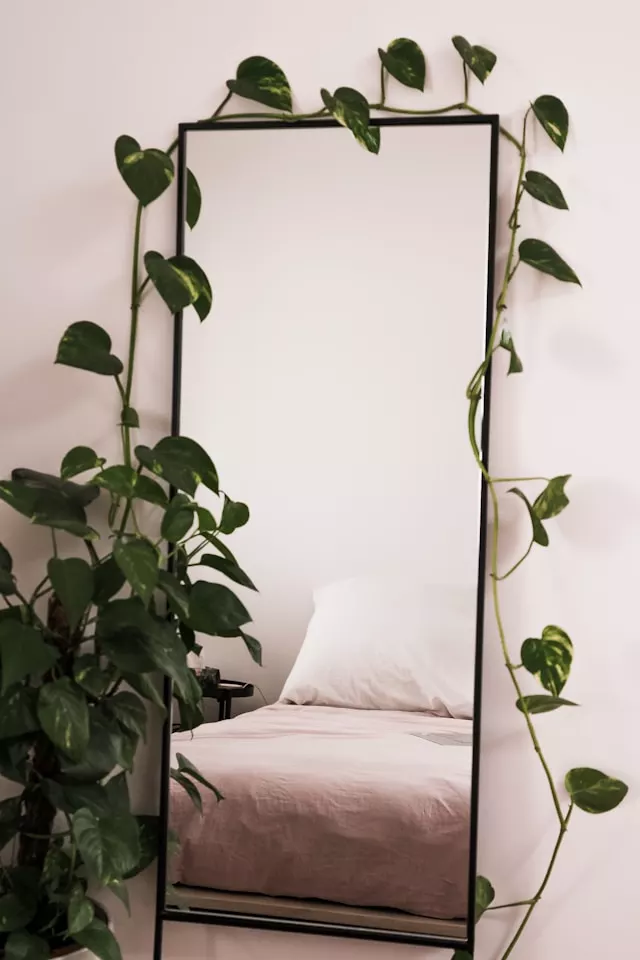
Feng shui is that ancient Chinese practice of arranging your space to balance energy — or “chi” — so you can feel better, have stronger relationships, and even attract more prosperity. When it comes to bedrooms, one of the most common mistakes I see (and one of the most damaging) is a mirror facing the bed. But here’s the thing: most people get why it’s a problem totally wrong.
| ❌ What Most People Think | ✅ What It Actually Means |
|---|---|
| “A mirror facing the bed is bad luck.” | The mirror bounces erratic, jittery energy back at you all night long — making deep, restful sleep almost impossible. More than that, it reflects the parts of yourself you haven’t fully accepted, whether you realize it or not. |
Let me break it down simply: Mirrors are inherently yang energy — active, bright, and energizing. Your bedroom, though? It’s supposed to be a haven of yin energy: quiet, restorative, and all about turning inward. When you put a yang element (that mirror) directly across from the most yin activity you do (sleep), you’re setting up a constant, unspoken conflict. It’s like trying to relax in a room that’s quietly buzzing with energy you can’t turn off.
Your bedroom should be the one place where you can fully unplug — no pretense, no performance. But when a mirror faces your bed, that reflection keeps your subconscious running on high all night. Sometimes, it even reflects a version of yourself you’re not ready to see — the parts you hide from the world, even when you’re alone.
For a broader look at how mirrors work in feng shui — including their role in different rooms and how they interact with the bagua map — check out our complete guide on whether mirrors are feng shui.
What Feng Shui Practitioners Actually Say
A lot of traditional feng shui masters will tell you the original warning about mirrors facing the bed was practical, not just spiritual: Waking up in the middle of the night, half-asleep, and catching your own startled reflection? It’s genuinely unsettling. But over centuries, that warning has deepened — and modern practitioners see it as something far more impactful than just a late-night scare.
Here’s what we really mean when we say a mirror facing the bed is a problem:
- It disrupts your energetic field while you sleep. Your body never fully drops into that deep, restorative state it needs to recharge — you’re always subtly “on edge,” even when you’re unconscious.
- It reflects your own image back at you, creating a quiet psychological pressure: the feeling of being watched in your most vulnerable state. Even if you don’t consciously notice it, your brain picks up on that “presence.”
- For couples, it symbolically invites a “third party.” Some practitioners believe the mirror’s reflection splits your combined energy, creating a subtle, unspoken distance between you two — like there’s an extra presence in the room.
- It keeps the energy in the room from settling. Instead of quieting down overnight, the chi bounces around, keeping the space feeling “restless” — and that restlessness seeps into your sleep.
In relationship-focused feng shui, this setup often invites misunderstanding, distance, or even external interference — what we call “third-party energy.” It’s not about cheating or drama; it’s about the subtle way that reflected energy can weaken the bond between two people.
Why This Matters Beyond Superstition — The Science
I know what you’re thinking: “This sounds like superstition.” But here’s the good news: Modern research on sleep and our sensory environment actually backs up this ancient wisdom — more than you might expect.
Reason #1: Light reflection
Mirrors bounce light — from nightlights, your phone, even moonlight — and that light can unintentionally brighten your room when it should be dark. Your brain’s production of melatonin (the hormone that helps you fall and stay asleep) is super sensitive to light. Even a little bit of illumination can throw it off.
Harvard researchers found that typical room lighting can significantly suppress melatonin, delaying when it kicks in and shortening how long it lasts. When a mirror is positioned to catch and redirect that light, it’s like multiplying the light sources in your room — making your dark bedroom less dark than it needs to be for good sleep.
Reason #2: Distraction and anxiety
Our brains process reflections automatically — you can’t choose to ignore the figure in the mirror moving slightly as you shift in bed. That creates a constant, low-level sensory input that keeps your nervous system from fully shutting down.
A study from Royal Society Publishing demonstrated this perfectly: Participants in a virtual reality experiment felt physical sensations when a reflected hand (in a mirror) was touched — even when their real hand wasn’t. That strong link between vision and physical sensation explains why mirrors in bedrooms can be so distracting during sleep, when you’re at your most vulnerable.
Researchers at Washington University School of Medicine also found neural circuits in the retina that constantly sense movement — even when you’re not consciously paying attention. That means your sleeping brain might be picking up on the subtle movement of your own reflection all night long, keeping you from fully relaxing.
Reason #3: Subtle movement detection
Now, let’s be honest: There’s no big, peer-reviewed study titled “Mirrors Facing Beds Cause Insomnia” [4†L43-L44]. But the cumulative evidence? It strongly supports the feng shui principle. Visual stimuli — including reflections — do interfere with sleep quality, even when you don’t consciously notice them.
Melatonin doesn’t just help you fall asleep; it helps you stay asleep, too. Any light source that reduces melatonin can fragment your sleep — meaning you’re waking up briefly throughout the night, even if you don’t remember it. A 2011 study found that typical room lighting can suppress melatonin enough to delay its onset and shorten its duration by up to 90 minutes. More recent research shows even dim light — the kind that lets you navigate the room but not read — can affect your cardiometabolic health, including heart function and blood sugar.
So that passive light from a mirror-reflected source? It’s not just disturbing your sleep — it might be quietly affecting your body’s long-term health, too.
Reason #4: Bed arrangement shapes your subconscious
Beyond light and movement, there’s a more subtle factor: how your bed’s orientation makes you feel. In feng shui, placing your bed directly in line with a door (we call it the “coffin position”) creates a subconscious feeling of vulnerability. The same goes for mirrors — even while you’re sleeping, your brain is picking up on cues about safety, exposure, and whether you’re being “observed.”
If your brain feels like you’re being watched (even by your own reflection), it can’t fully let go — and that keeps you from getting the deep sleep you need.
The “coffin position” — where your bed is directly in line with the door — is one of the most common bedroom feng shui mistakes, right alongside mirrors facing the bed. Learn how to fix it in our complete guide to the command position.
Signs Your Mirror Might Be Affecting You — Even If You Don’t Realize It
Mirrors are everywhere in American bedrooms — on closet doors, bathroom thresholds, wall art, dressers — so most of us barely notice them. But if you have any reflective surface facing your bed and any of these sound familiar, it’s worth paying attention:
- You wake up feeling like you didn’t sleep at all — even after 7 or 8 hours in bed.
- Your dreams are vivid, anxious, or recurring — especially dreams about being watched, exposed, or chased.
- You and your partner have subtle tension — you can’t put your finger on why, but there’s a distance that wasn’t there before.
- You avoid looking at your reflection at night — that quick glance before bed feels unsettling, like something’s off.
- You wake up with a vague sense of dread or restlessness — even when nothing specific is wrong in your life.
I had a reader, Sarah M., reach out to me in 2025 with this story: “I’d been waking up at 3 a.m. for almost a year. I tried everything — new pillows, blackout curtains, a white noise machine. Nothing worked. Then an interior designer told me about the mirror thing. The night I covered the mirror on my closet door, I slept through the night for the first time in 12 months. I’m not saying it’s magic — but I’m not saying it’s not.”
Recent psychological research suggests mirrors intensify self-consciousness — and for couples, that reflected “third person” can subtly plant seeds of mistrust in your subconscious. Over time, that can erode your emotional connection without you even realizing it.
How to Fix It — Simple Solutions for Better Sleep
The best part? Fixing a mirror-facing-bed issue is one of the easiest changes you can make in your bedroom — and most people notice a difference within a few nights, not weeks. Here are my go-to solutions, ranked by ease:
Option 1: Cover It at Night (5 seconds, $0)
This is the simplest fix ever: Drape a cloth, throw blanket, or scarf over the mirror before bed. Every feng shui expert I know agrees that even this small act changes the room’s energy immediately. Pick fabrics with calming textures in soft, warm colors — think neutrals or pastels — to keep the yin energy strong.
Pro tip: Keep a decorative throw draped over the top of the mirror during the day so it looks intentional, not like an afterthought. Then just pull it down at night — easy peasy.
Option 2: Remove It Entirely
If the mirror is small enough to move, relocate it to another room. Hallways, dressing areas, or living rooms are perfect — mirrors work great in high-energy spaces. They just don’t belong facing your bed.
Option 3: For Mirrored Closet Doors, Use Frosted Film
This is my favorite solution for the most common problem: mirrored sliding closet doors. Grab some static-cling frosted window film (you can find it on Amazon for $15–30). It turns any reflective surface into a translucent panel — you still get privacy, and you can still use your closet, but it’s no longer a mirror. The best part? It’s removable and leaves no residue, so it’s renter-friendly.
Option 4: Add a Room Divider
If you can’t remove or cover the mirror, place a folding screen, tall plant, or large piece of furniture between the bed and the mirror. This blocks the reflection while keeping the mirror usable for your daily routine. It’s perfect for rental apartments where you can’t modify permanent fixtures.
Option 5: Reposition Your Bed
If the mirror is built into the wall or attached to a bathroom door, just shift your bed so it’s no longer directly facing the reflection. Even moving it a few feet to the side can break the line of sight — and fix the energy.
Quick Comparison Table
| Solution | Cost | Difficulty | Effort | Effectiveness |
|---|---|---|---|---|
| Cover at night | $0 | Easy | 5 seconds | High |
| Reposition bed | $0 | Moderate (requires lifting) | 15–30 min | Very High |
| Move mirror to another room | $0 | Easy to moderate | 10 min | Very High |
| Frosted film | $15–30 | Easy | 20–40 min | Very High |
| Room divider | $50–200 | Easy | 5 min to set up | High |
Once you’ve covered or removed the problematic mirror, the next question is: where should you put mirrors in your bedroom? Our guide to safe mirror placement covers the best spots — side walls, closet interiors, and other positions that actually support good energy flow.
The Deeper Lesson: Your Bedroom Doesn’t Lie
Let’s circle back to Blake Lively, Michele Monique Reis, and that mirror above your bedside table. Here’s the truth: Your bedroom is the one room in your home that holds your unfiltered truth.
Out in the world, we’re all curating an image. We post the vacation photos, not the fights. We smile at the Met Gala hours after a lawsuit settles because we want people to believe everything’s fine. But at night, when the lights go out and you’re lying in bed — sometimes staring at your own reflection in the dark — that curated image falls away. There’s no audience, no performance, just you and the truth you’ve been hiding.
Feng shui teaches that whatever you’re keeping hidden — a secret, a fear, an unspoken truth, a part of yourself you’re not ready to accept — your bedroom will reflect it back. Mirrors facing the bed are just one symptom of that deeper pattern. But they’re also the easiest one to fix.
You don’t have to wait for a courtroom or a public scandal to start being honest with yourself. You can start tonight — by looking at your bedroom with new eyes and asking: What is my mirror actually showing me?
Frequently Asked Questions
Does every mirror in the bedroom cause problems?
Nope! A mirror inside a closet (facing inward, only visible when the door’s open) is totally fine. A wall-mounted mirror that doesn’t reflect the bed? Also fine. The issue is only when the mirror reflects the bed while you’re sleeping.
What about mirrored furniture — nightstands, dressers, headboards?
Yes, those count too. In feng shui terms, any reflective surface facing the bed creates the same problem. If it reflects your sleeping body, it’s worth covering, refinishing, or moving.
How quickly will I notice a difference?
Most people tell me they notice a difference within 3–5 nights after covering or removing the mirror. The first morning, you might wake up feeling a little more rested, a little less anxious — like something’s “off” in a good way. The full effect builds over about two weeks, as your body gets back into deeper sleep cycles and your cortisol levels balance out.
I live alone — does this still matter?
Honestly? More than ever. When you live alone, your bedroom is the space where you have the most intimate relationship — the one with yourself. A mirror facing the bed reflects back not a partner’s energy, but your own. That can be powerful if you’re ready to do some self-inquiry — but if you’re not, it can feel like a subtle, constant discomfort. Either way, fixing the mirror placement helps create a space where you can truly rest in your own skin.
What if I can’t move the mirror because I’m renting?
Renters have great options! Covering the mirror at night, using removable frosted film, placing a room divider, or repositioning your bed (which costs nothing and isn’t permanent) all work. Pick the one that fits your lease and your landlord’s rules — no damage, no stress.
For a more detailed step-by-step guide — including which solution works best for each room type and what to do if none of these options fit your space — see our complete mirror-facing-bed cure guide.
Is there any scientific study that explicitly proves mirrors facing beds cause insomnia?
There’s no single, big peer-reviewed study that directly tests “mirror facing bed → insomnia” as a cause-and-effect. But there’s tons of research on how light disrupts melatonin, how our brains process reflected movement, how mirrors amplify self-consciousness, and how visual stimuli affect sleep. All of that together supports the feng shui principle: Reflective surfaces in the bedroom do mess with sleep quality, even when you don’t consciously notice it.
In short: It’s not “proven” by one study, but it lines up perfectly with what we know about sleep and our environment.
Your Next Step: Tonight
You don’t have to wait to start improving your sleep. Try this tonight:
- Take a look around your bedroom and find any mirror or reflective surface that faces your bed.
- Cover it with a cloth, towel, or scarf — just for one night — and see how you feel in the morning.
- Take a minute to reflect (pun intended) on what else in your space might be hiding a truth you’d rather not see.
- Pick one of the five solutions above and make it a permanent change.
- Notice how your sleep changes over the next week — I think you’ll be surprised.
Sometimes the smallest shift in your environment creates the biggest shift in your life — and your sleep.
“Your bedroom mirror doesn’t just show you your face — it shows you your truth. The question is: are you ready to look?”
Want to check your entire bedroom layout for other hidden energy drains? Use our free Bedroom Feng Shui Assessment Tool — it evaluates your room’s energy flow and pinpoints problem areas in 60 seconds.